The history of money is not a straight line towards progress. It is a series of exchanges where each advancement solved a concrete problem and, almost always, created another. It's worth following step by step, because the problem created by the last step is the subject of this entire course.
The first major leap was metal. Salt melts in the rain, cattle die, shells break, and cocoa rots. Gold and silver do none of these: they don't rust, don't spoil, can be cut and melted into smaller pieces without losing value, and are hard to find. A handful of metal concentrates the value of a cartload of grain, solving durability, divisibility, and portability all at once.

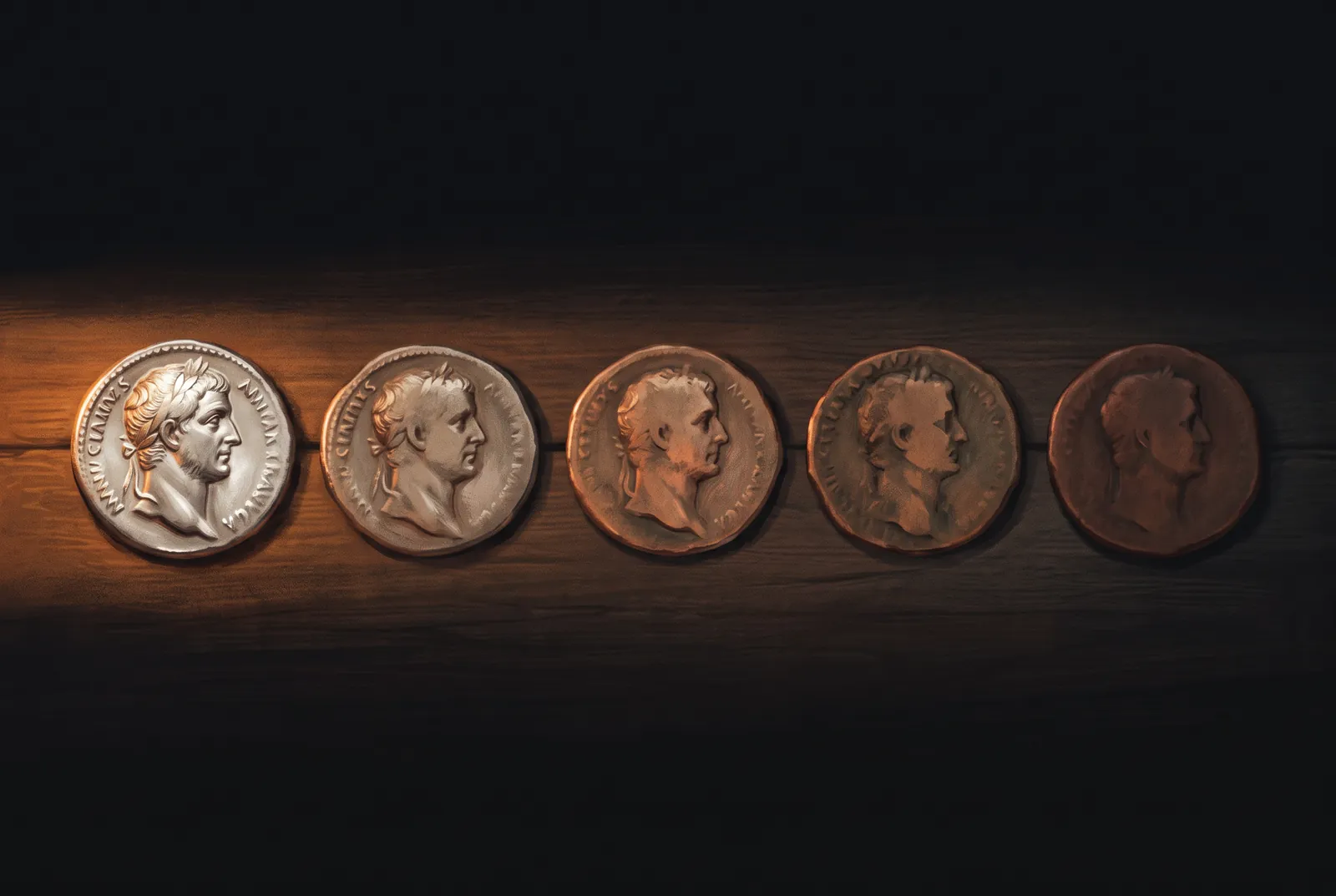
But metal bars have a practical flaw: for each payment, someone needs to weigh and test the purity. The second leap was coinage. A coin with the issuer's mark is metal already weighed and tested — the mark is an economy of verification. It was Lydia, in present-day Turkey, around the 7th century BC, that popularized the idea. Along with it came the flaw: the minter can reduce the metal inside the coin and keep the same face value. Roman emperors did this for centuries until the silver denarius had practically no silver left. It is the first documented inflation in history, and it didn't need any printing press.
The third leap was the receipt. Carrying gold is dangerous and heavy, so people began leaving the metal with goldsmiths and merchants, who returned a paper saying "the bearer of this document is entitled to so much gold stored here." As the paper was more practical than the metal, it began to circulate in place of the metal. Thus, paper money was born: not as a government invention, but as a receipt that came to be worth as much as the stored item.
And here appears the flaw that defines the modern world. Goldsmiths realized that almost no one withdrew the gold at the same time, and that they could issue more receipts than there was metal in the vault. As long as no one suspected, it worked. It is the seed of fractional reserve banking, which is the subject of Lesson 5.

The fourth leap was centralization. Instead of a thousand issuers, just one: the central bank, with the monopoly on issuance and the promise of conversion into gold. In 1944, with Europe in ruins, the Bretton Woods agreement extended the logic to the entire world — national currencies were convertible into dollars, and the dollar was convertible into gold at 35 dollars an ounce. The entire planet was hanging on a single promise.
The fifth step was the breaking of that promise. The United States spent more dollars than they had gold to back, especially with the Vietnam War and social programs, and other countries began to demand conversion. On August 15, 1971, Richard Nixon announced on national television the suspension of the dollar's convertibility into gold. It was presented as a temporary measure. It was never reversed.

Since then, the world's money is fiat — the word comes from fides, faith in Latin. A real or dollar bill is not a receipt for anything: it has value because the law says it is a means of payment and because everyone continues to accept it. And, as there is no longer a vault limiting issuance, the amount of money has become a policy decision, not a fact of nature.
Notice the pattern. Each stage traded the quality of money for convenience of use, and the cost was borne by those who saved money. Metal is inconvenient but no one manufactures gold; backed paper is convenient but someone can issue more; fiat currency is extremely convenient and has no limit other than the decision of the issuer.
The question that remains is: can we have both? Money as convenient as a digital file and as limited as gold? This question remained without a practical answer for forty years. The answer is the subject of the next modules.