No one sends a bitcoin to anyone. Nothing leaves your phone and arrives on someone else's phone, no file crosses the internet carrying value inside. What crosses is an announcement: a short message saying that certain coins, which until now could only be moved by someone with a key, can now only be moved by someone with another key. Everything else is the network agreeing with this announcement.
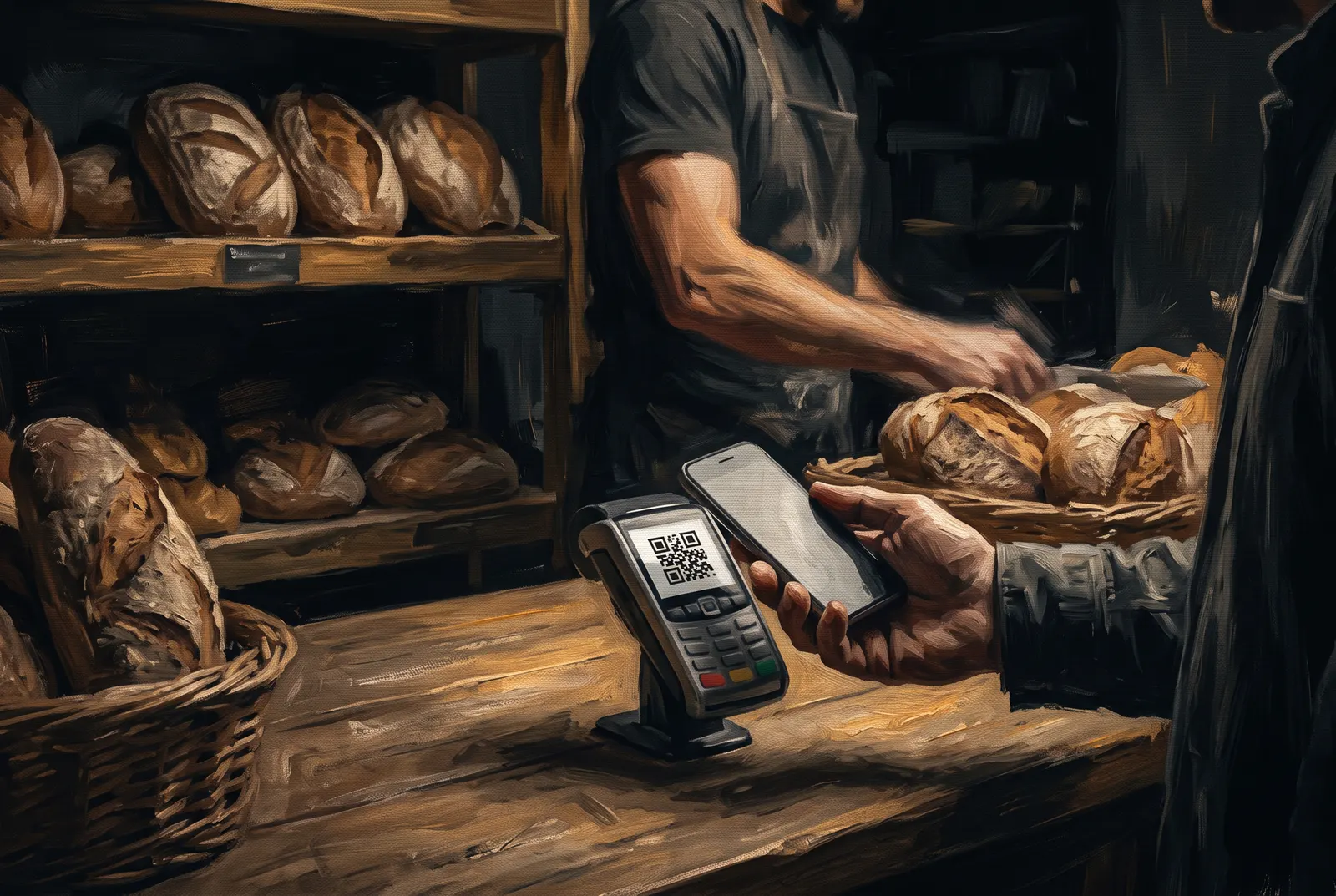
On a Saturday morning, a bakery accepts bitcoin. The purchase amount appears on the card machine's screen as a black and white grid. You point your phone's camera, and the app reads two pieces of information from it: a destination and an amount. No name, no document, no institution in between.
The wallet constructs the transaction. It looks at the coins you've received before — pieces, each with its own size, not a single balance like a bank statement — and chooses which ones to use. If the chosen piece is larger than the purchase, it creates a second output returning the difference to you. It's the change, and it exists because you can't split a piece in half without spending it entirely. This detail has an entire module reserved for it later on.
Authorization is needed. The wallet signs the transaction with your private key, which never leaves the device. The signature doesn't reveal the key; it proves, to anyone who wants to check, that the person who wrote that message had the key capable of moving those coins. It's the chain of signatures from Lesson 1 gaining another link.
Then the message goes out. Not to a Bitcoin server, because there isn't one. Your app delivers the transaction to some computers participating in the network, and each of them does the same thing: checks if the signature matches, if the coins exist, and if they haven't been spent yet, and if everything is correct, they pass it on to their neighbors. In a few seconds, the transaction is on tens of thousands of machines worldwide. None of them asked anyone for permission to accept it.

Now it waits. Each of these machines stores valid transactions that haven't yet entered any block in a waiting room called the mempool. It's not a queue by order of arrival. Whoever builds the next block chooses what goes inside, and they choose based on who pays better for space — the fee. Paying little on a busy day means waiting; paying well means entering the next block. It's an auction, and you placed your bid when you pressed "send."

Every ten minutes, on average, a miner somewhere in the world manages to close a block: a package with a few thousand transactions and a stamp that was expensive to produce. If yours was among them, it left the waiting room and entered the record. The miner didn't decide that your payment is valid — they only decided the order. Validity is determined by each computer that receives the block and checks it entirely, transaction by transaction, before accepting it. A block with an invalid transaction is rejected, and all the work of whoever built it becomes trash.
The payment now has a confirmation. From then on, each block stacked on top is another confirmation. There is no "definitive" stamp: there is depth. Undoing a payment with one confirmation would require redoing a block; undoing one with six would require redoing six, and faster than the rest of the world builds the next ones. That's why a house would wait for a few confirmations, and the bread leaves the counter immediately — the baker is taking a risk of a few cents, and he knows it.

Notice what didn't happen in this entire process. No one approved it. No company could have refused the payment because it's Saturday, because it's for abroad, or because they don't like who receives it. And no one can undo it afterward, which cuts both ways: there are no chargebacks, no support, and a wrongly entered destination can't be undone.
In the next lesson, the record where this block ended up: how a list of chained blocks makes rewriting the past expensive, and why so many people keep a copy of it.